

What happens after somebody buys their first tiny Bitcoin miner? Usually, something small. Occasionally — something wonderful.
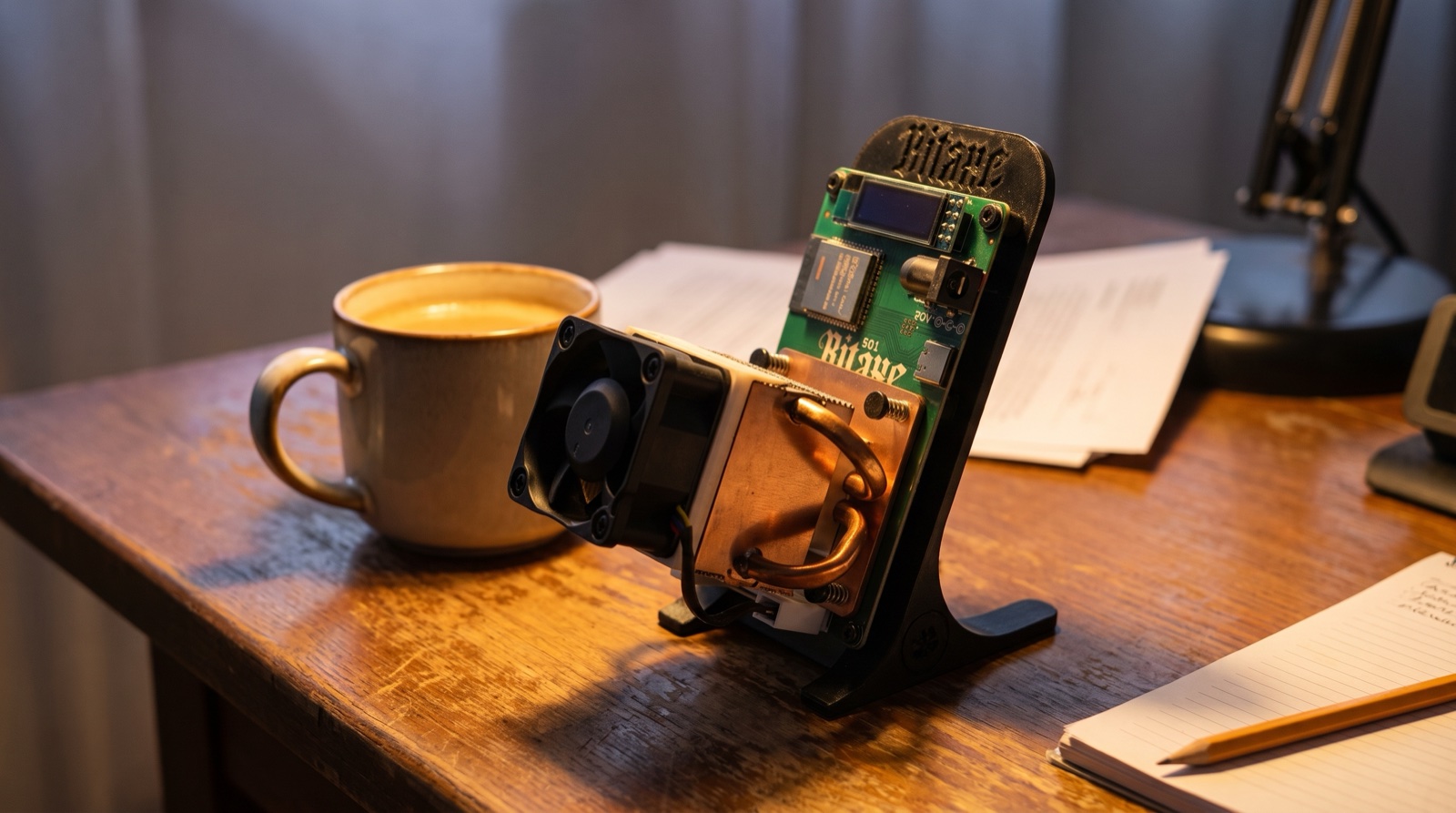
Month one. Every story starts here.
Every home-mining story starts the same way: one small box shows up in the mail. It's about the size of a deck of cards, it costs $95, and it draws less power than a phone charger.
What happens next is where the stories split. We run recorded research interviews with our customers, and across dozens of conversations, two very different arcs keep showing up. Both are worth telling — because one of them is probably going to be yours, and it's worth knowing which.
The arc almost nobody expects
A few weeks ago we interviewed a semi-retired customer in Las Vegas. Thirty-year career behind him, "decent retirement" — and, by his own account, still working 80 to 120 hours a week, because retirement apparently didn't take.
His first miner was the standard entry-level Bitaxe. Here's his own description of the next thirty days:
"At first, I started with the standard 1.2 terahash machines… went to the Gamma 1.6… then two Nano 3S 6-terahash machines. Then I progressed over the last thirty days into the 12-terahash NerdOctaxe."
— HD customer, Las Vegas
Thirty days. One desk gadget to twelve machines — about 38 terahash — in a dedicated, air-conditioned room. And no, his electric bill did not explode: "I don't anticipate spending more than forty to fifty dollars a month on my current setup."
He wasn't done:
"I have the capability of putting in my own mining vault on my property. That would be separate from the home. Bring in power directly to it… the AC unit, and all the ventilation."
— same customer
"I actually have the capability of putting solar power in also. It'll help me in electrical cost. Every day, I'm leaning more towards doing it at home."
— same customer
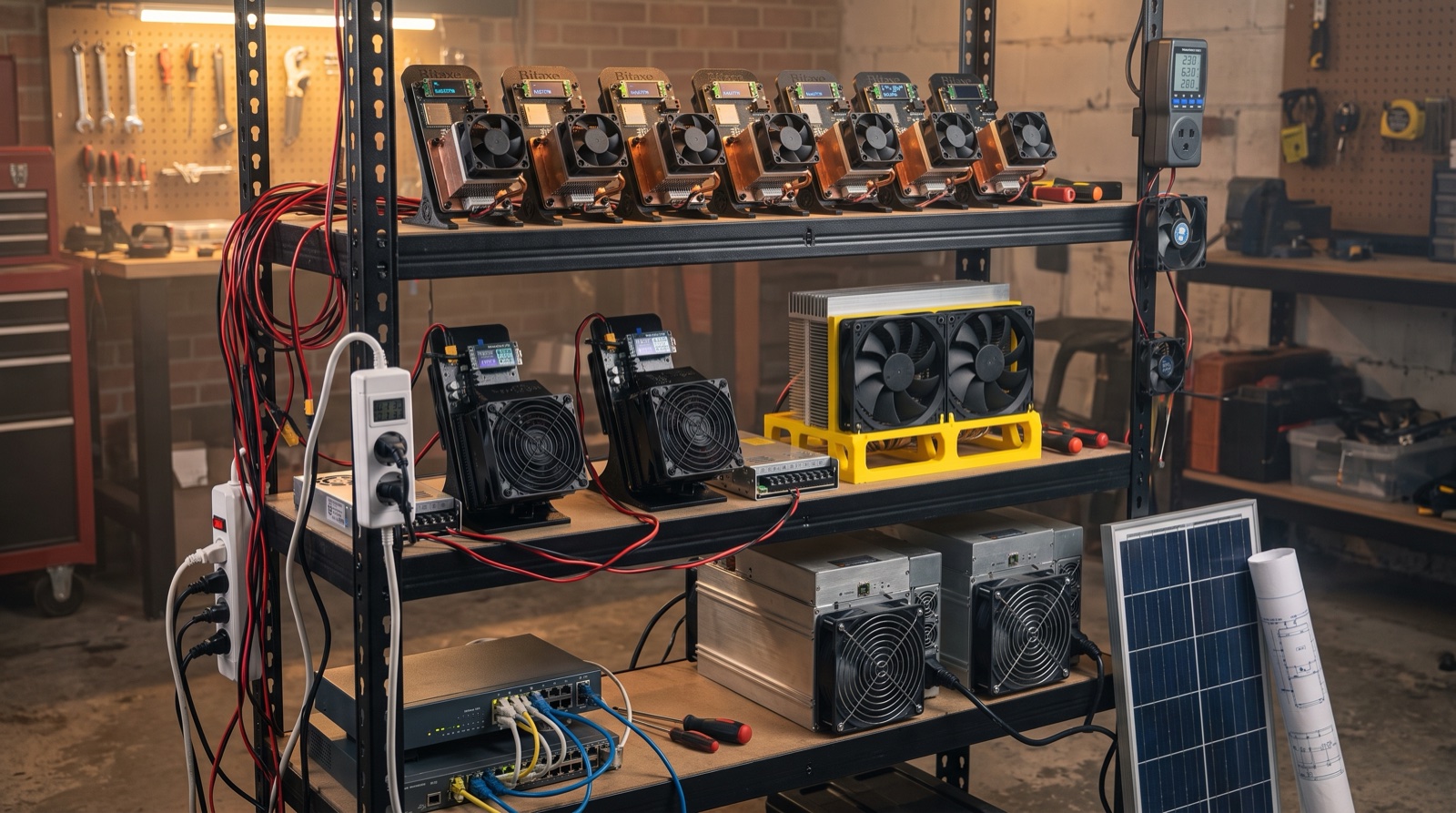
Month two. The dream: a little farm in the garage — Gammas, NerdQaxes, the big iron, and a solar panel waiting.
A mining vault. On his own land. Fed by his own solar. That's the full arc — desk gadget to micro-farm — and he's climbing it with small, open-source machines you can buy one at a time, not warehouse hardware.
He's not the only one on that ladder. Another customer we interviewed bought his first Bitaxe as, essentially, homework — he's changing careers into the mining industry:
"I preferred to learn the basics and get engaged with it at a small scale that I could run at home… For the price point, you really can't go wrong in order to learn the mechanics of the mining network."
— HD customer, career-changer
His version of the dream is even further out there: a fully off-grid build — solar panels, batteries, the miner running straight off DC. ("Ultimately, you have constraints. What do you do for Internet?" — a real question he's genuinely working on.) The $95 box is the first rung of a ladder that, for him, ends in a career.
The arc almost everybody actually lives
Now the honest part. Most customers we talk to are not building a vault. When we asked, most of them told us — clearly, sometimes proudly — that they never will:
"Not a major operation, just something small."
— California, four miners in the garage
"Nothing too big, noisy, expensive."
— HD customer, three Gammas on his desk
But here's what's funny: they keep growing anyway. Just… sideways. One small box at a time:
"Buying a miner here or there, worth a couple hundred bucks. Any chance I get — I'll continue to add."
— California
"You spend two hundred and fifty dollars to get one, and then maybe six to eight months later, another two hundred and fifty when you've got some extra money hanging around."
— HD customer, Georgia
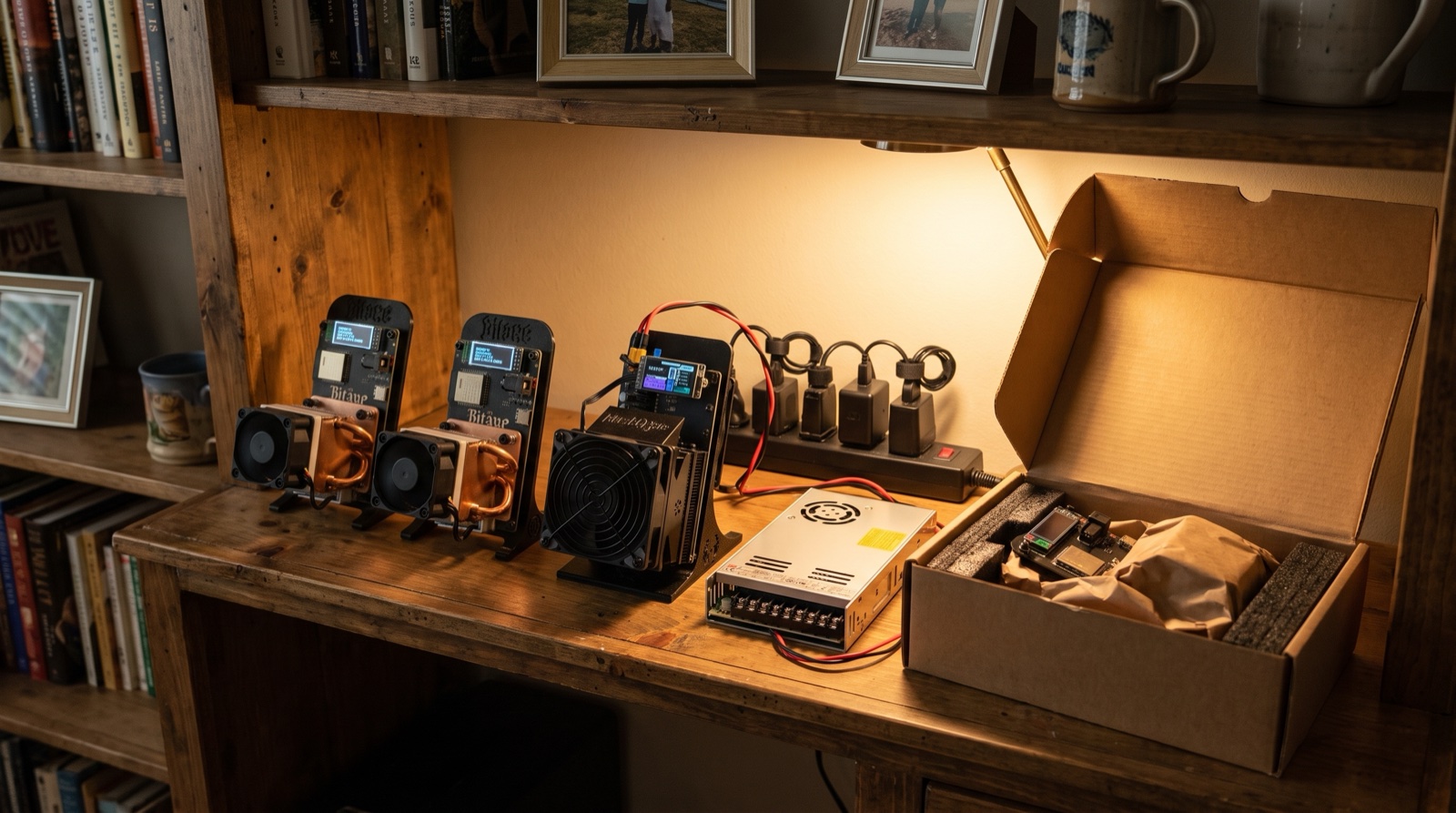
The stack-small arc: the shelf fills itself.
We've started calling this the stack-small arc: no farm, no blueprints, no second breaker panel. Just a shelf that quietly fills itself — a $95 or $249 box every few months, whenever there's a little extra money and a little extra curiosity. More lottery tickets, more little screens to check with your coffee, zero meetings with an electrician.
It's how the majority of home miners actually live. And it's a completely legitimate place to stop.
Two arcs, one first step
Here's the thing both groups agree on: nobody starts with the shed. The Vegas customer's vault began as one standard Bitaxe on a desk. The career-changer's off-grid dream began the same way. So did every four-box garage shelf we've heard about.
The first step is identical no matter which arc turns out to be yours. Plug it in, point it at the network, watch the little screen. Then wait and see which person you turn out to be. Most people add another box in a few months. A few people call an electrician.
Either way, the shelf has room.

Start with the $95 box — Bitaxe Gamma 601 V2
~15W · quiet enough for a bedroom · open source

Already stacking? NerdQaxe++ (6 TH/s)
$249 · ships with the metal Mean Well power supply
Customer quotes come from our recorded post-purchase research interviews, lightly edited for clarity and shared without names.
1 comment
I started with 6 tiny little NerdMiner ver.2 miners. The addiction grew to a BitAxe gama 601, then 3 more bitaxe gama 602, now Im waiting on a BSB B30. Iam determined to get the life altering block! Once I hit a block, then I will build my vault, I love this hobby, one day it WILL change my life!